
Do I pay workers' comp on subcontractors? On the uninsured ones, usually yes. If a subcontractor cannot be shown to have carried its own workers' compensation coverage for the period it worked for you, a premium audit treats that subcontractor's labor as your payroll and charges premium on it at the class rate that would have applied had those people been your employees. A subcontractor with verified coverage of its own is normally not charged to you at all.
Which makes this one of the few audit outcomes that is decided almost entirely by paperwork you either gathered at the time or did not.
When do I pay workers' comp on subcontractors, and when does the sub?
The mechanism is coverage of last resort. Workers' compensation law in most states pushes liability for an injured worker up the chain when the direct employer has no insurance, and the premium follows the liability.
South Carolina's Workers' Compensation Commission states the rule about as plainly as it gets: "Employees of a subcontractor are statutory employees of a general contractor." And then the consequence: "A general contractor is liable for their statutory employees in the event their subcontractors do not maintain their own workers' compensation insurance coverage." That exposure is real whether or not anyone thought about it when the work was scheduled, and your carrier prices it.
Note what the commission does not say. It does not say this depends on how the subcontractor was paid. Asked whether paying by 1099 settles the question, the answer is that "the method of payment to workers is not the sole determining factor." A 1099 describes how money moved. An auditor is looking at the working relationship, and the two are different subjects.
The threshold for who must carry coverage at all varies by state. South Carolina requires it at four or more employees, and that count includes part-time workers and family members.
What does a certificate of insurance actually prove?
Less than most people assume, and this is where audits go wrong.
A certificate of insurance is evidence of coverage on the day it was issued. It is not a guarantee that the policy stayed in force. A subcontractor whose policy cancels for non-payment in June still has a perfectly clean certificate dated March sitting in your file, and the audit covering June will charge you for that subcontractor's labor.
Tennessee's guidance is specific about the failure modes. It advises contractors to confirm coverage with the insurance agent rather than relying on a certificate handed over by another contractor, because fraudulent documents are a real risk. It tells general contractors to keep copies of subcontractors' certificates and to monitor expiration dates at least monthly. It also flags a trap for out-of-state subs: Tennessee requires coverage listed in "3A" on the certificate rather than merely "3C," and notes that the distinguishing information "is not displayed on the COI," so direct verification with the carrier is the only reliable check.
One more thing Tennessee makes explicit, because people get it wrong constantly: "Workers' compensation is a separate insurance category; it does not fall under general liability or an umbrella policy." A general liability certificate proves nothing about comp.
Tennessee also allows the I-15 Form, which brings a subcontractor under the general contractor's own policy with the subcontractor's agreement. That is a deliberate choice to absorb the exposure rather than an accident, and it prices accordingly.
| What you have | What the audit does with it |
|---|---|
| Certificate covering the full period worked, verified with the carrier | No charge for that subcontractor |
| Certificate that expired mid-job | Charges the uncovered portion |
| General liability certificate only | Charges the full amount as uninsured |
| Nothing | Charges the full amount as uninsured |
| Subcontractor brought onto your policy by agreement | Priced as your payroll from the start |
How brief does the work have to be before it stops counting?
It does not stop counting. A Virginia Court of Appeals decision issued February 24, 2026 made that binding in that state.
Gencon, a small basement and kitchen remodeling contractor with two direct employees, carried no workers' compensation insurance. When an employee was seriously injured by a collapsed concrete wall in March 2022, the question became whether Gencon met Virginia's three-employee threshold, given that it regularly brought in subcontractors' workers for electrical, drywall, and countertop work. The court held that it did. Duration of the engagement was, in the court's words, "beside the point," and a company cannot avoid the obligation by "structuring its workforce around short-term outside help."
The reasoning generalizes past the headcount question it was answering. A contractor who thinks of the electrician as a vendor rather than as labor is using a distinction the statute does not make. At audit, that same electrician either has coverage on file or becomes a line on your worksheet.
What to gather before the audit starts
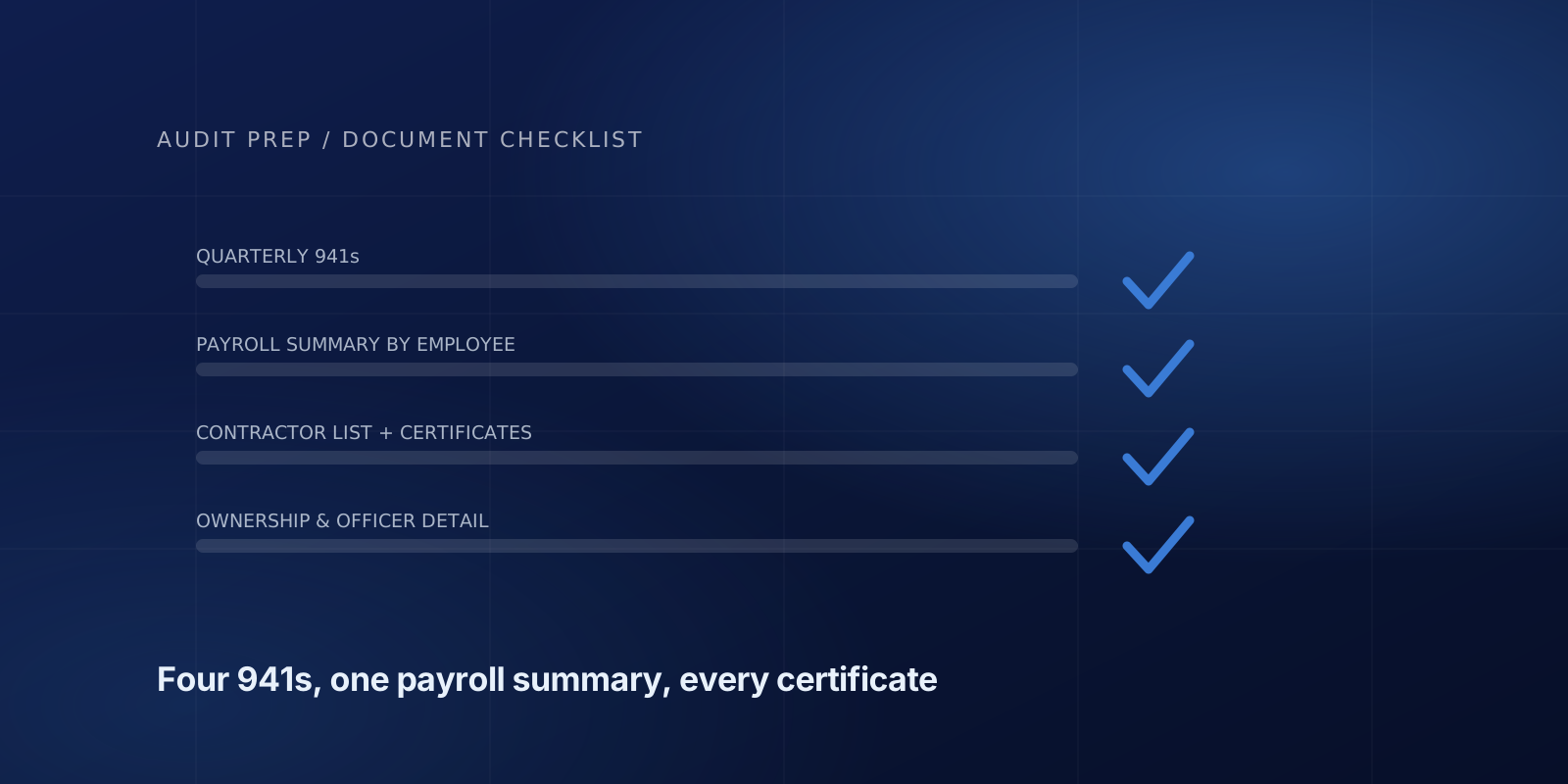
Pull every subcontractor you paid during the policy period, from the check register rather than from memory, and put a verified certificate against each one covering the actual dates worked. Where a certificate is missing, find out now whether the subcontractor had coverage, because a certificate obtained in week one of an audit still counts and one obtained after the worksheet is signed does not.
Then separate labor from materials on each invoice. If an invoice reads as one number, the auditor is entitled to charge the whole number, and a $40,000 invoice that was $12,000 of labor and $28,000 of granite will be priced as $40,000 of payroll unless your records say otherwise. That split is worth more than almost anything else in the file, and it is the same principle that governs what payroll counts in a workers' comp audit generally.
Running the numbers before the auditor does is the cheap version of this exercise. The subcontractor exposure tool will show you what an uninsured subcontractor costs at your own class rates, which is usually the moment the certificate chase starts looking like a reasonable use of an afternoon.
State rules differ on nearly every detail here, including thresholds, exemption forms, and what counts as a subcontractor in the first place. What does not differ is the order of operations: no verified coverage, your payroll.
Frequently asked questions
Do I pay workers comp on subcontractors?
On uninsured ones, usually yes. If a subcontractor cannot be shown to have carried its own workers' compensation coverage for the work it did, the auditor treats that subcontractor's labor as your payroll and charges premium on it. A subcontractor with verified coverage of its own is normally not charged to you.
What is a statutory employee?
A worker who is treated as your employee by statute rather than by contract. South Carolina states the rule directly: employees of a subcontractor are statutory employees of a general contractor, and the general contractor is liable for them if the subcontractor does not maintain its own coverage.
Does paying someone on a 1099 mean I don't owe workers comp premium?
No. South Carolina's commission says the method of payment to workers is not the sole determining factor. The tax form describes how money moved, not what the working relationship was, and an auditor is looking at the relationship.
Is a certificate of insurance enough proof for an audit?
Only if it covers the right dates and the right coverage. A certificate shows coverage as of the day it was issued, so a policy cancelled the following month still produces a clean-looking certificate. Tennessee advises confirming coverage with the insurance agent rather than relying on a certificate handed over by another contractor.
Can hiring subcontractors make me large enough to need coverage?
In some states, yes. A Virginia Court of Appeals decision issued February 24, 2026 held that brief stints by subcontractors' workers count toward the state's three-employee threshold, so a contractor with two employees on payroll can still be required to carry coverage.