Premium audit is the only mechanism that moves a 4.8% payroll increase into a book whose premium did not move at all. NCCI's 2026 State of the Line put private carrier net written premium at $41.6 billion for 2025, down 0.2%, while its own payroll measurement for the same year rose 4.8%. Those two numbers cannot both be right about the same exposure unless something in between is failing to convert one into the other, and the audit is that something.
The 2025 figures are unusual in a specific way. Workers' compensation stayed profitable, so the pressure is not solvency. The pressure is that growth has nowhere to come from except accuracy.
What NCCI's 2026 State of the Line said about premium
Premium went flat while exposure grew. The report, presented in May 2026 on 2025 data, gives both sides of that:
| Measure | 2025 figure |
|---|---|
| Private carrier net written premium | $41.6 billion, down 0.2% |
| Calendar year combined ratio | 91, up from 86.1 in 2024 |
| Accident year combined ratio | 102 |
| Payroll change | up 4.8% |
| Lost-time claim frequency | down 2% |
| Medical and indemnity claim severity | each up 4% |
Workers' compensation was the only major property and casualty line whose premium shrank. The calendar year combined ratio of 91 is still an underwriting gain, and NCCI estimated a redundant industry reserve position of $14 billion, down from roughly $16 billion the year before. The accident year ratio of 102 is the number that says the current year, on its own terms, is not paying for itself.
Donna Glenn, NCCI's chief actuary, summarized the loss side as follows: "Frequency continues to decline, severity is nuanced but explainable, and industry and state mix matter." Medical claim severity rose 4% in 2025 and indemnity claim severity rose 4%.
Why a 4.8% payroll increase does not arrive as premium
Because the policy was priced on a payroll figure set before any of that growth happened. NCCI's presentation splits the 4.8% into its two components, and the split is the whole point:
| Component of 2025 payroll growth | Contribution |
|---|---|
| Employment | 0.5% |
| Wage rate | 4.3% |
Growth from employment tends to be visible. A policyholder who adds a crew usually tells somebody, because headcount changes show up in endorsement requests, in certificate requests, and in the broker's renewal conversation. Growth from wage rate is silent. Nobody calls their carrier to report that they gave raises, and the policy's estimated payroll does not update itself when they do.
So in a year where 4.3 of the 4.8 points came from wages, the exposure increase was structurally invisible to the policy as written. It existed in the payroll records the whole time. It reaches the carrier only when somebody opens those records, which is the audit, and only if the audit is completed and billed.
That is a different problem from the one carriers usually describe as premium leakage. The classic version is misclassification or concealed payroll, and it has a culpable party. The 2025 version needs no bad actor at all. An honest policyholder, an accurate application, and a carrier that set estimated payroll from last year's audit produce the gap on their own.
Where does premium audit sit in a combined ratio of 91?
On the premium side of the ratio, which is why it moves every component at once. NCCI's component breakdown shows where the five points between 2024 and 2025 came from:
| Combined ratio component | 2024 | 2025 |
|---|---|---|
| Loss ratio | 44.2 | 47.7 |
| Loss adjustment expense ratio | 13.7 | 13.4 |
| Underwriting expense ratio | 26.6 | 28.0 |
| Dividends | 1.6 | 1.5 |
The loss ratio rose 3.5 points and the underwriting expense ratio rose 1.4. Both are ratios to premium. Premium that was earned on exposure already written, and that goes unbilled because an audit was never finished, inflates both of them without a single additional claim.
This is the part that gets mis-filed as a timing issue. An audit that lands late is a timing issue. An audit that does not get done is not, because the claims arising from the unreported payroll were already priced into the loss ratio. The exposure was on risk for the full term. Only the premium for it is optional.
What to measure when accuracy is the only lever
Three things, and none of them is audit volume.
Completion rate by segment, not overall. An aggregate completion percentage hides the accounts that matter, because the accounts hardest to audit are disproportionately the ones whose payroll moved. Small construction accounts with no accounting staff behave differently from scheduled manufacturing risks, and an 88% book-wide figure can contain a 60% segment.
Audit-to-estimate variance, tracked as a distribution rather than an average. In a year where wage rate contributed 4.3 points, a book whose average variance is near zero is not accurate. It is a book where upward corrections and downward ones cancelled out, which means two populations are being priced wrongly in opposite directions. The workers' comp estimated payroll problem shows up here first.
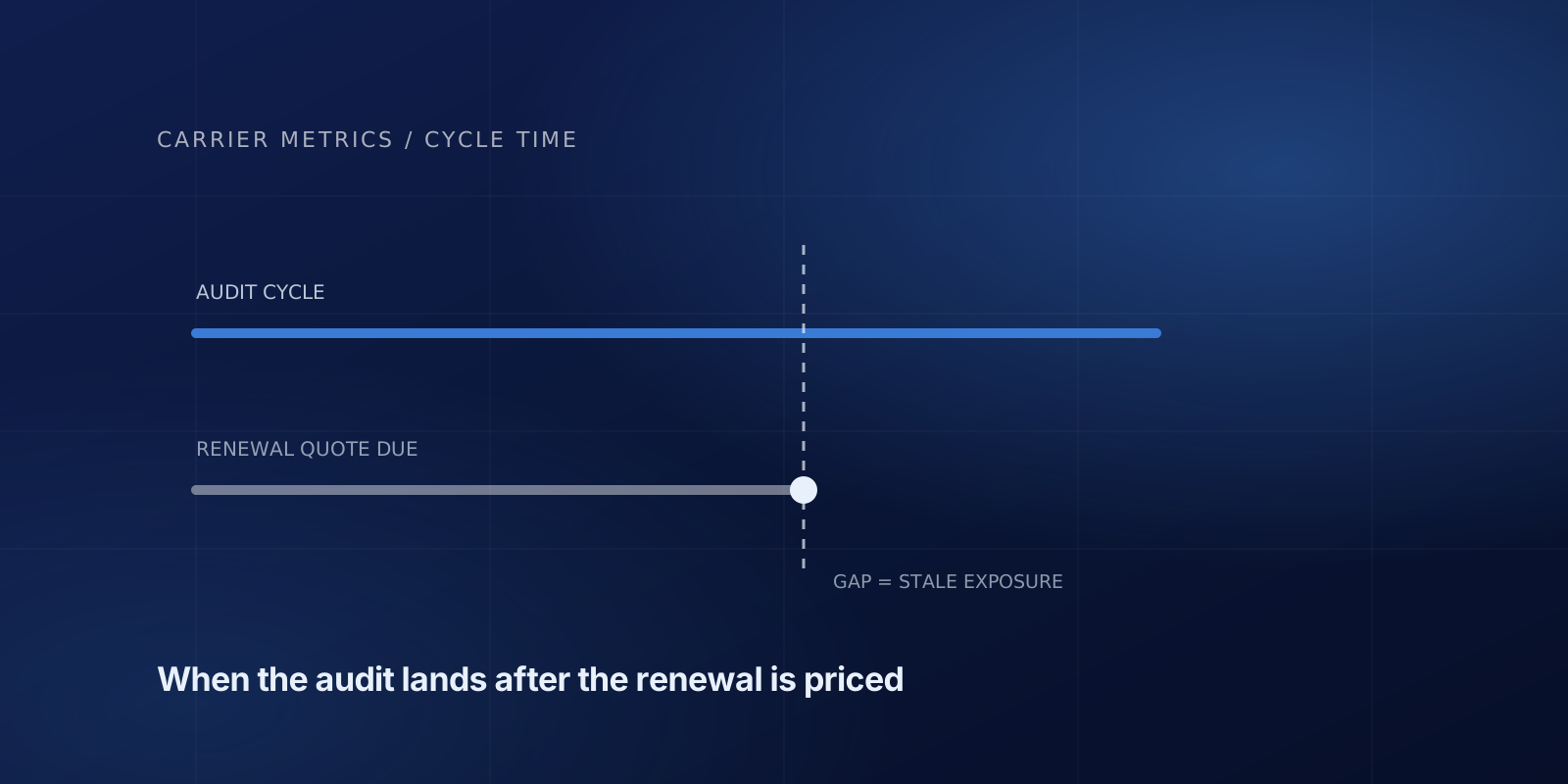
Days from expiration to billed, because the collectability of additional premium decays with age and the policyholder's ability to pay it decays faster. An audit finished in 45 days and an audit finished in 180 days are not the same asset, which is the argument for putting audit turnaround on the carrier scorecard.
The number to watch next
The 2025 payroll split is the figure to carry into renewal season. If wage rate contributes another 4 points in 2026 and estimated payroll is still being set from the prior audit, the gap compounds rather than resets, because each year's estimate inherits a base that was already a year behind.
NCCI reports State of the Line each May. The question its 2027 edition will answer is whether premium followed payroll or stayed flat for a third year.
Frequently asked questions
What did NCCI report for workers compensation premium in 2025?
Private carrier net written premium was $41.6 billion, down 0.2%. NCCI's 2026 State of the Line also put the calendar year 2025 combined ratio at 91 and the accident year 2025 combined ratio at 102.
How much did payroll grow in 2025?
4.8%, according to NCCI's State of the Line presentation. Employment contributed 0.5% of that and wage rate contributed 4.3%, so almost all of the growth came from existing workers being paid more rather than from more workers.
Why doesn't payroll growth show up as premium growth?
Because premium is booked on estimated payroll at inception and only corrected at audit. A 4.3% wage-rate increase during a term is invisible to the policy as written, and it reaches the carrier as audit premium after the term ends, if the audit is completed.
Where does premium audit sit in a combined ratio of 91?
On the premium side, not the expense side. NCCI's component figures show the loss ratio rising from 44.2 to 47.7 and the underwriting expense ratio from 26.6 to 28.0 between 2024 and 2025. Audit premium raises the denominator those ratios are measured against.
Isn't an uncollected audit just a timing problem rather than a loss?
Not when the exposure was already on risk. The claims from unreported payroll are priced into the loss ratio whether or not the premium for that payroll is ever billed, so an audit that goes uncompleted converts measured exposure into free coverage.