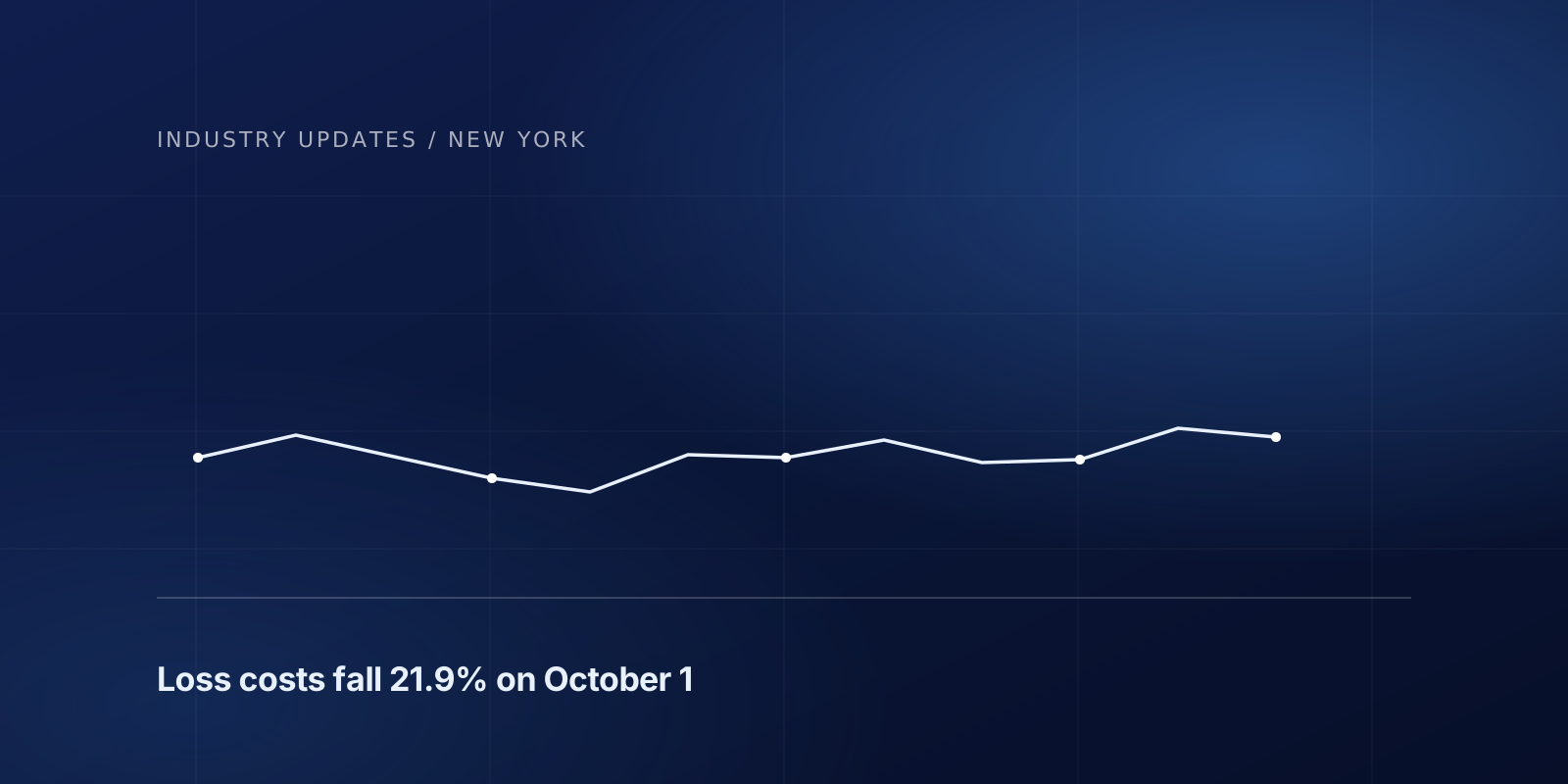
New York workers' compensation loss costs fall 21.9% for policies written or renewed on or after October 1, 2026. The New York State Department of Financial Services approved the New York Compensation Insurance Rating Board's filing on July 15, 2026, and the overall change includes a 22.7% decrease in the average manual loss cost level.
That is the headline. It is also the number least likely to describe any particular employer, because the filing changes classification loss costs, officer payroll limits, and one classification's entire exposure basis at the same time.
What the Rating Board filed, and what DFS approved
The explanatory memorandum accompanying R.C. Bulletin 2659 breaks the overall change into pieces. The latest two policy years of loss experience produced a 1.1% decrease. Benefit level changes, covering the maximum weekly benefit increases set in the 2007 reform legislation and the minimum weekly benefit increases signed into law in September 2023, added 2.4%. A review of loss adjustment expense data took 0.6% off. The memorandum also describes a net trend selection built on declining claim frequency, rising indemnity and medical severity, and a projected wage trend.
Two provisions did not move. The terrorism loss cost provision stays at $0.029 per $100 of payroll, and the natural disasters and catastrophic industrial accidents provision stays at $0.003 per $100 of payroll.
Which policies get New York's new workers' compensation loss costs?
Policies effective on or after October 1, 2026. Nothing changes mid-term.
This is the part worth being precise about, because loss costs are fixed to the policy rather than to the calendar. A New York policy that incepted on September 20, 2026 runs its full twelve months on the old level, and the audit at the end of that term prices audited payroll using the rates attached to that policy, not the ones in effect on the day the auditor does the work. The reduction reaches that employer at the following renewal.
New York Insurance Law section 2347(c) also requires insurers to give an insured whose premium is affected by a rate change an estimate of the change, and the reasons for it, at least 30 days before billing.
Why the statewide average says so little about one employer
Exhibit B of the bulletin lists a loss cost for every employment classification alongside the prior value. The spread is wide.
| Class code | New loss cost | Prior loss cost | Change |
|---|---|---|---|
| 2302 | 1.253 | 2.035 | −38.4% |
| 9058 | 1.375 | 2.216 | −38.0% |
| 9040 | 3.013 | 2.972 | +1.4% |
| 1439 | 3.194 | 2.543 | +25.6% |
An employer whose payroll sits mostly in a class that rose does not experience a rate cut at all. Which is the practical reason class code assignment deserves more attention in a year like this one, not less. When the statewide average falls and one of your classes rises, a misassignment that used to cost a few points now moves premium in two directions at once.
The payroll rules changed alongside the rates
Three items in the revision touch what an auditor will be looking at.
Maximum and minimum remuneration amounts were updated. Executive officers in non-construction employments are subject to a maximum of $3,100 per week and a minimum of $1,025 per week. Construction employments use $1,922.25 per week, effective July 1, 2026. Non-executive officers in classifications whose footnotes limit maximum remuneration carry $8,250 per week. Officers of not-for-profit unincorporated associations carry a $525 weekly minimum. These are the figures that decide how much of an owner's pay enters the premium base, and they are where officer payroll caps get applied in practice.
The Wage and Credit Table for the Construction Classification Premium Adjustment Program was updated to reflect New York's July 1, 2026 prevailing wages, applicable to eligible policies effective on or after October 1, 2026. CCPAP credits run from 10% to 25% depending on average hourly wage, and they are earned on payroll records. A contractor whose wages sat comfortably inside a credit band last year should check the new table rather than assume the credit carries forward.
Class code 9027 changes its exposure basis from a per-location basis to payroll on October 1, 2026. The code is being discontinued effective October 1, 2028 after a three-year transition, and this is the first step. Any risk carrying 9027 will be reporting a different kind of number to its carrier from October forward.
What to do with this before October
For an employer renewing in the fourth quarter, the useful exercise is not celebrating the 21.9%. It is pulling the classification breakdown off the renewal and checking each code against Exhibit B, because the statewide figure and the figure attached to your payroll can sit more than sixty points apart. For a carrier, the October 1 boundary is worth flagging in the audit queue: expiring policies and new ones are now priced off two different loss cost levels, and an auditor who reaches for the current manual on a policy that incepted in September will produce a number the insured is right to dispute.
The classification detail is published. The employers who read it before the renewal quote arrives are the ones who catch an assignment that no longer fits. Understanding what payroll counts in a workers' comp audit is the other half of that check.
Frequently asked questions
When do New York's new workers' compensation loss costs take effect?
October 1, 2026. The revision applies to policies written or renewed on or after that date. A policy that incepted in September 2026 keeps the old loss cost level for its entire term.
Will a 21.9% loss cost decrease cut my premium by 21.9%?
No. The 21.9% is a statewide average across all classifications, and loss costs are only the starting point. Carriers apply their own loss cost multiplier, then the experience modification and any schedule credits or debits, and the final premium is set on audited payroll.
Did every New York class code get a decrease?
No. Individual classification loss costs in the filing range from decreases of more than 38% to increases above 25%. Class code 1439 rose 25.6% and class code 9040 rose 1.4%, while codes 2302 and 9058 fell 38.4% and 38.0%.
What changed for New York officer payroll at audit?
The maximum and minimum remuneration amounts were updated effective October 1, 2026. Executive officers in non-construction employments carry a maximum of $3,100 per week and a minimum of $1,025 per week, and construction employments use $1,922.25 per week.